
Brushing cleans the front, back, and chewing surfaces of your teeth, but toothbrush bristles cannot reliably reach every narrow space between them. That is why cleaning between your teeth is an important part of preventing plaque buildup, gum inflammation, bad breath, and cavities between adjacent teeth.
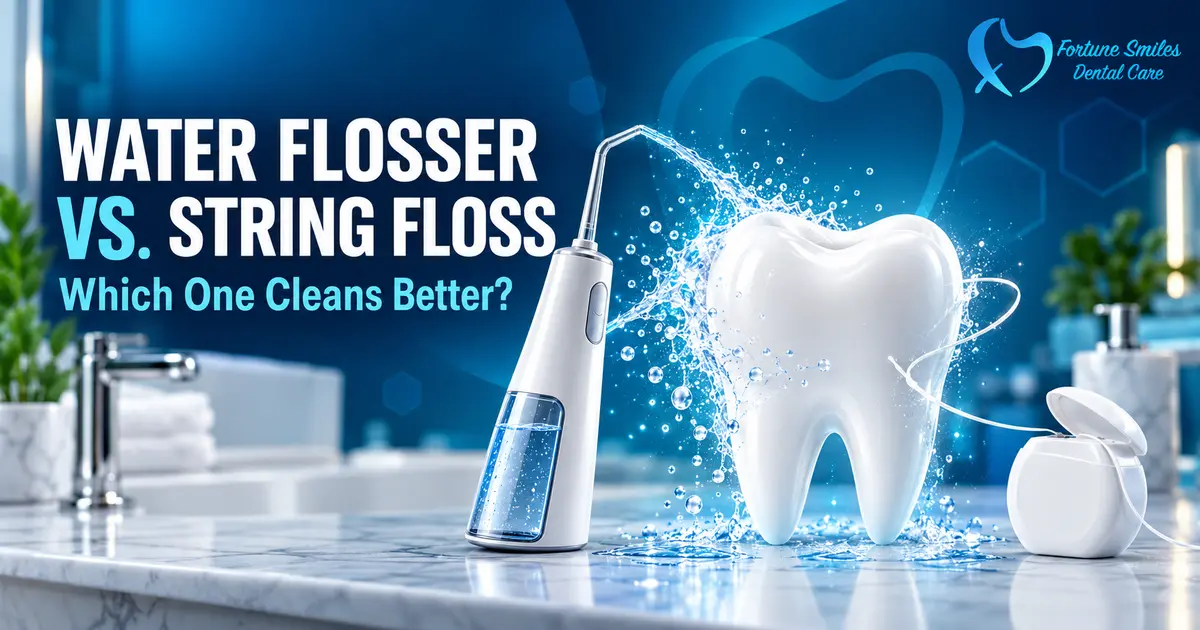
The question is whether traditional string floss or a water flosser does the better job. String floss makes direct contact with the sides of each tooth, while a water flosser uses a pulsating stream of water to flush around the teeth and gumline. Both can improve oral hygiene, but each method has different strengths.
In the water flosser vs floss comparison, the best choice is usually the tool that suits your mouth, dental work, dexterity, and daily habits. Some patients benefit from string floss, some find a water flosser easier, and others achieve the best results by using both.
Quick Answer: Is a Water Flosser Better Than Floss?
A water flosser is not automatically better than string floss for every person. String floss can wipe plaque directly from tightly touching tooth surfaces. A water flosser is often easier to use and can be especially helpful around braces, bridges, implants, crowns, and areas that are difficult to reach with regular floss.
- For tight contacts: string floss often provides better direct surface contact.
- For bleeding or sensitive gums: a correctly adjusted water flosser may feel gentler.
- For braces and bridges: water flossing is usually more convenient.
- For limited hand mobility: a water flosser may be easier to control.
- For the best real-world result: choose the method you can use correctly and consistently every day.
Why Brushing Alone Is Not Enough
Plaque is a sticky film of bacteria that continuously forms on the teeth. A toothbrush removes plaque from exposed surfaces, but the spaces between neighboring teeth can remain partly untouched. Food particles may also collect beneath the contact point or along the gumline.
If plaque remains in these areas, the gums may become red, swollen, tender, or prone to bleeding. Plaque can eventually harden into tartar, which cannot be removed with a toothbrush, floss, or water flosser at home. It requires professional dental cleaning.
The American Dental Association recommends cleaning between the teeth once daily with floss or another interdental cleaner. This should complement—not replace—brushing twice a day with fluoride toothpaste and attending regular dental examinations.
Water Flosser vs String Floss at a Glance
| Feature | String Floss | Water Flosser |
|---|---|---|
| Cleaning method | Physically wipes the sides of teeth | Uses pulsating water around teeth and gums |
| Tight tooth contacts | Very useful when inserted correctly | Cleans around the contact but does not scrape both surfaces |
| Braces and fixed bridges | Effective but may require threaders or special floss | Usually faster and easier to maneuver |
| Ease of use | Requires hand control and correct technique | Often easier after a short learning period |
| Travel | Small, inexpensive, and highly portable | Portable models exist but require more space |
| Cost | Low ongoing cost | Higher initial cost and occasional tip replacement |
| Mess and setup | Minimal setup | Requires water and may splash during early use |
How String Floss Cleans Between Teeth
String floss is designed to pass through the contact between two teeth. Once below the contact point, the floss should be curved into a C shape against one tooth and moved gently up and down. The process is then repeated against the neighboring tooth.
This direct wiping action is the main advantage of string floss. When used properly, it can disrupt plaque that adheres to the tooth surface rather than simply removing visible food. It is particularly helpful when the spaces between teeth are too narrow for an interdental brush.
However, floss is technique-sensitive. Snapping it forcefully into the gums, moving it only straight up and down through the contact, or failing to wrap it around each tooth can make cleaning less effective and may irritate the gum tissue.
How a Water Flosser Works
A water flosser, also called an oral irrigator, directs a controlled stream of pulsating water between teeth and along the gumline. Most models allow you to adjust the pressure and use different tips for general cleaning, orthodontic appliances, periodontal pockets, or dental restorations.
Water flow can remove loose debris and disturb plaque around areas that are difficult to access. Clinical studies have also found that water flossers can help reduce gum bleeding and gingival inflammation when used with regular toothbrushing.
A water flosser does not reproduce the exact wiping action of string floss. Its value comes from its ability to irrigate complicated areas and from being easier for many patients to use consistently.
What Does the Research Actually Show?
Research comparing interdental cleaners is more complicated than many product advertisements suggest. Studies differ in device design, user technique, treatment duration, gum health, and the way plaque or bleeding is measured.
Some short-term clinical trials have reported greater reductions in gum bleeding with water flossers than with string floss. Research involving orthodontic patients has also found water irrigation useful for reducing plaque and bleeding around fixed braces.
That does not prove that every water flosser removes more plaque from every surface than correctly used string floss. String floss still has the advantage of direct physical contact with the sides of teeth. Water flossers may produce better results for some people because they are easier to use thoroughly and consistently.
The practical conclusion: effectiveness depends on the device, your dental condition, your technique, and whether you actually use the method every day.
Who May Benefit Most From a Water Flosser?
People With Braces
Brackets and wires create numerous areas where food and plaque can collect. Threading floss under an orthodontic wire is effective, but it can be time-consuming. A water flosser with an orthodontic tip can make daily cleaning around brackets easier.
People With Bridges, Implants, or Crowns
Fixed bridges and implant-supported restorations can have spaces beneath or around them that regular floss cannot enter without a threader. Water flossing can help flush these areas, although your dentist may also recommend implant floss, interdental brushes, or another specialized tool.
People With Limited Dexterity
Arthritis, hand injuries, tremors, and other mobility limitations can make it difficult to control string floss. Holding and guiding a water-flosser handle may be more manageable.
People Who Avoid String Floss
An interdental cleaner cannot help if it remains unused. If string floss feels so difficult that you regularly skip it, a water flosser may be a more realistic way to establish a daily routine.
When String Floss May Be the Better Choice
String floss remains a strong choice for people with healthy gums, tightly spaced teeth, good hand control, and no complex dental appliances. It is inexpensive, easy to carry, and does not require batteries, charging, or a water reservoir.
It can also provide valuable feedback. If floss catches, tears, or repeatedly shreds in one location, there may be a rough filling, tartar deposit, damaged restoration, or cavity that should be examined by a dentist.
Patients who already floss correctly every day and have healthy gums may not gain much by abandoning a routine that works. A water flosser can still be added when recommended, but buying a device is not automatically necessary.
Which Method Is Better for Different Dental Needs?
Tight, Natural Teeth
String floss is often the simplest way to clean and wipe the closely contacting surfaces.
Braces
A water flosser can simplify cleaning around brackets and wires, but it should be part of a complete orthodontic hygiene routine.
Dental Implants
A water flosser may help around implant restorations, but pressure, tip selection, and other cleaning tools should follow professional guidance.
Sensitive Gums
Low-pressure water flossing may feel more comfortable, although persistent tenderness or bleeding requires a dental evaluation.
Permanent Bridges
Water flossing is convenient beneath bridgework, but floss threaders or interdental brushes may provide additional surface contact.
Frequent Travelers
String floss is more portable, although compact cordless water flossers are available.
How to Use String Floss Correctly
- Break off approximately 18 inches of floss and wind most of it around the middle fingers.
- Guide the floss gently between two teeth without snapping it into the gums.
- Curve the floss into a C shape against one tooth.
- Slide it gently below the gumline and move it up and down against the tooth surface.
- Repeat against the neighboring tooth before removing the floss.
- Advance to a clean section as you move around the mouth.
If regular floss is difficult to grip, a floss holder or pre-threaded flosser may help. Do not repeatedly reuse the same piece of floss because it can fray, lose effectiveness, and transfer debris.
How to Use a Water Flosser Without Making a Mess
- Fill the reservoir with lukewarm water and attach the recommended tip.
- Begin with the lowest comfortable pressure setting.
- Lean over the sink and place the tip in your mouth before switching the device on.
- Keep your lips partly closed so water can drain into the sink.
- Aim the stream approximately at a right angle to the gumline.
- Pause briefly between teeth and trace the gumline around the entire mouth.
- Empty and clean the reservoir according to the manufacturer’s instructions.
Higher pressure does not necessarily mean better cleaning. Excessive pressure can be uncomfortable, especially if your gums are inflamed. Increase the setting gradually only when it remains comfortable and follows your dentist’s recommendation.
Does Bleeding Mean You Should Stop?
Bleeding during flossing often occurs when plaque has caused gum inflammation or when a person is restarting interdental cleaning after a long break. Gentle, consistent cleaning may help the gums become healthier and bleed less over time.
Do not ignore bleeding that is heavy, painful, localized to one area, or continues despite good daily care. Persistent bleeding can be associated with gingivitis, periodontitis, damaged dental work, medication effects, or another health concern. Schedule a professional examination rather than increasing pressure or flossing aggressively.
Can You Use Both Water Floss and String Floss?
Yes. Using both is reasonable when each method has a clear purpose. String floss can wipe tight contacts, while a water flosser can clean around braces, restorations, implants, or gumline areas that are difficult to reach.
Using both every day is not essential for every patient. A complicated routine may even reduce consistency if it feels too time-consuming. Your dentist or dental hygienist can identify where plaque and bleeding occur and recommend the simplest effective combination.
Patients wearing clear aligners should also keep their teeth clean before reinserting the trays. Our guide to cleaning and caring for Invisalign aligners explains how oral hygiene fits into daily aligner care.
How to Choose a Water Flosser
Choose a device with adjustable pressure, a tip that suits your dental needs, and a reservoir large enough for a complete cleaning session. Countertop models generally offer larger reservoirs and more settings, while cordless models are easier to store or take when traveling.
An ADA Seal of Acceptance provides additional reassurance that a specific product has been evaluated for safety and effectiveness for its stated claims. Avoid assuming that every inexpensive device performs identically simply because it produces a stream of water.
If you have implants, active gum disease, recent oral surgery, or complex dental work, ask your dental team which tip and pressure setting are appropriate before beginning.
Common Mistakes With Water Flossers and Floss
| Mistake | Why It Matters | Better Approach |
|---|---|---|
| Snapping floss into the gums | May cut or irritate gum tissue | Guide floss gently through the contact |
| Flossing only visible food | Plaque remains attached to tooth surfaces | Clean both sides of every contact |
| Starting a water flosser on maximum pressure | Can cause discomfort and discourage continued use | Start low and increase gradually |
| Moving the water stream too quickly | Important areas may be missed | Trace the gumline and pause between teeth |
| Using either tool only occasionally | Plaque reforms continuously | Clean between teeth once every day |
Interdental Cleaning Does Not Replace Dental Visits
Neither string floss nor a water flosser can remove hardened tartar. These tools also cannot diagnose cavities, periodontal pockets, failing restorations, or infection. Professional examinations and cleanings remain necessary even when your home-care routine is excellent.
At a dental visit, the hygienist can identify the areas you regularly miss and demonstrate the most appropriate technique for your mouth. A personalized recommendation is especially useful if you have gum recession, crowded teeth, braces, implants, bridges, or a history of gum disease.
Fortune Smiles Dental Care provides examinations, professional cleanings, periodontal assessments, and individualized home-care guidance through our general dentistry services.
Not Sure Which Flossing Method Is Right for You?
Bring your floss, water-flosser tip, or questions to your next visit. The Fortune Smiles team can recommend a daily routine based on your gums, tooth spacing, restorations, and personal comfort.
Frequently Asked Questions
Can a water flosser completely replace string floss?
A water flosser can serve as the primary interdental cleaner for many patients, particularly when string floss is difficult to use. However, people with tight contacts may benefit from the direct wiping action of string floss. Ask your dentist which method fits your mouth.
Which is better for removing plaque?
Correctly used string floss physically wipes plaque from tooth surfaces. Water flossers can also reduce plaque and gum inflammation, especially around difficult areas. The better method depends on tooth spacing, dental work, technique, and consistency.
Should I water floss before or after brushing?
Either order can work if you clean thoroughly. Many patients prefer to water floss first to loosen debris and then brush with fluoride toothpaste. The most important factor is completing both steps consistently.
Can water flossing damage gums?
A water flosser is generally safe when used as directed. Begin with a low pressure and avoid forcing the tip into gum tissue. Ask your dentist for guidance after gum surgery or if you have advanced periodontal disease.
Is a water flosser good for braces?
Yes. Water flossers can make it easier to clean around brackets and beneath orthodontic wires. Your orthodontist may still recommend additional tools, such as an interdental brush or floss threader, for specific areas.
How often should I use a water flosser or string floss?
Clean between your teeth once a day unless your dentist recommends a different schedule. Choose a convenient time so the routine is easier to maintain consistently.
Disclaimer: This article provides general educational information and is not a substitute for an examination, diagnosis, or personalized advice from a licensed dentist. Product and technique recommendations vary according to individual oral health needs.