
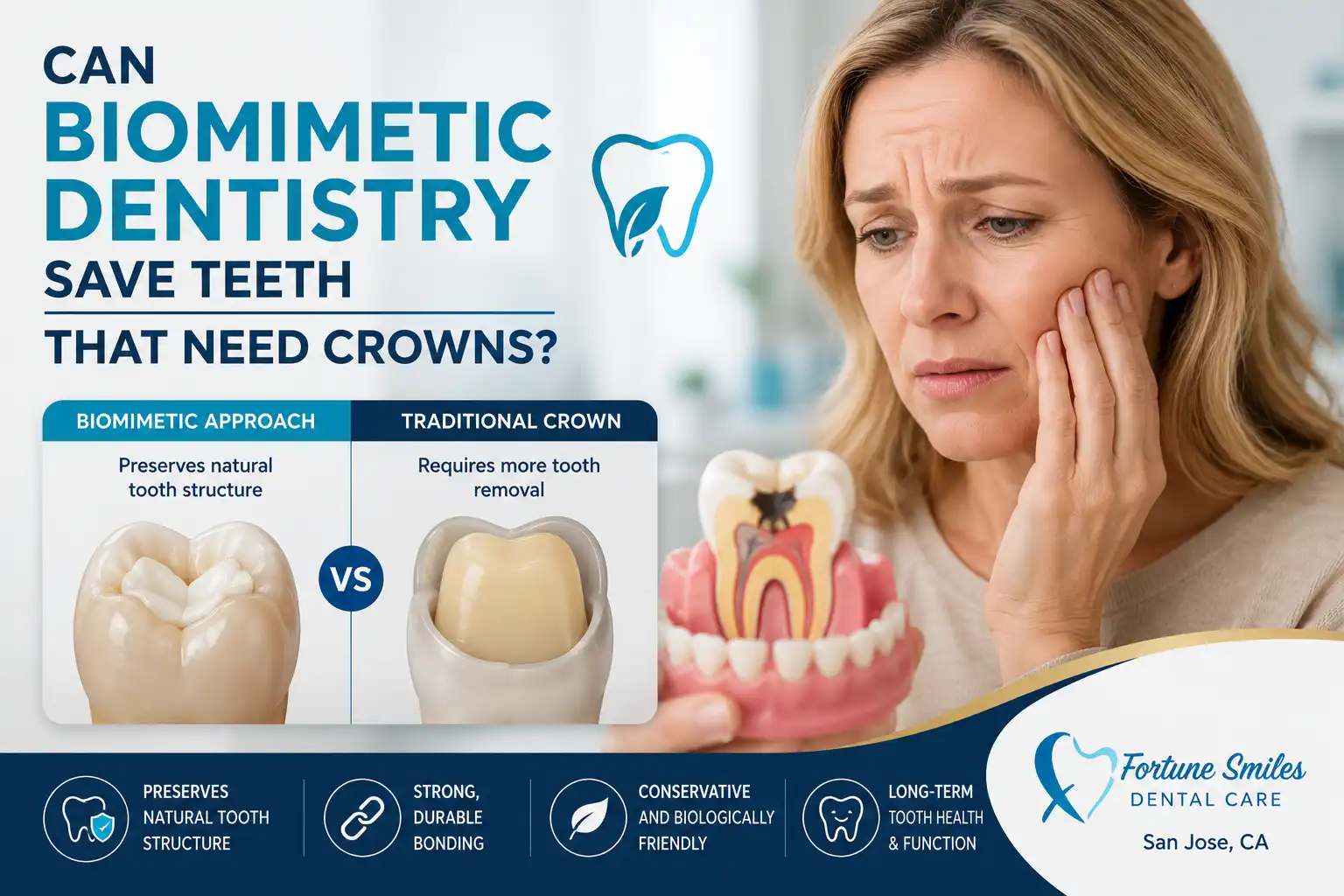
Not every damaged tooth automatically needs a full dental crown. In many cases, biomimetic dentistry may help preserve more natural tooth structure while restoring strength, comfort, and function.
Quick Answer
Yes, biomimetic dentistry can sometimes save teeth that might otherwise be treated with traditional crowns. Instead of removing large amounts of healthy tooth structure, biomimetic techniques focus on conserving enamel and dentin, bonding restorations securely, and rebuilding the tooth in a way that mimics natural strength and function.
If your dentist has told you that you need a crown, you may wonder if there is a more conservative option. Traditional crowns can be effective, but they often require significant tooth reduction. For some patients, especially those with cracked teeth, large fillings, weakened enamel, or moderate structural damage, biomimetic dentistry may offer an alternative approach.
At Fortune Smiles Dental Care, Dr. Forutan and the team focus on preserving natural tooth structure whenever possible. Patients from San Jose, Blossom Valley, Alamitos, Robertsville, and neighborhoods near Westfield Oakridge often choose conservative dentistry because they want strong, natural-looking results without unnecessary tooth removal.
What Is Biomimetic Dentistry?
Biomimetic dentistry is a modern approach to restorative dental care that aims to imitate the natural structure, function, and strength of real teeth. The word “biomimetic” means “mimicking life.” In dentistry, that means restoring damaged teeth in a way that behaves more like the original tooth.
Instead of automatically preparing a tooth for a full crown, a biomimetic dentist evaluates how much healthy structure can be preserved. The goal is to remove only damaged or infected areas, then use advanced bonding techniques and conservative restorations to reinforce the tooth.
This approach may be used for:
- Large cavities
- Cracked teeth
- Worn teeth
- Failing old fillings
- Teeth weakened by previous dental work
- Moderate structural damage
- Teeth at risk of needing crowns
Why Traditional Crowns Are Not Always the First Choice
Dental crowns are common and can be very useful when a tooth is severely weakened, fractured, or heavily restored. However, placing a crown typically requires reshaping the entire tooth so the crown can fit over it.
That means some healthy enamel and dentin may be removed along with damaged structure. Once that natural structure is gone, it cannot grow back.
This is where biomimetic dentistry becomes valuable. If enough healthy tooth remains, a more conservative restoration may protect the tooth without reducing it as aggressively as a traditional crown preparation.
Preserve More Tooth
Biomimetic dentistry focuses on keeping as much healthy enamel and dentin as possible.
Advanced Bonding
Modern bonding materials can help rebuild teeth with strength and stability.
Natural Function
The goal is to restore teeth in a way that looks, feels, and functions naturally.
Can Biomimetic Dentistry Replace a Crown?
In some cases, yes. Biomimetic dentistry may replace the need for a traditional crown when the tooth still has enough healthy structure to support a bonded restoration.
Instead of covering the entire tooth with a crown, your dentist may recommend an inlay, onlay, overlay, or bonded composite restoration. These restorations are designed to repair only the damaged portion of the tooth while preserving healthy areas.
For example, if a tooth has a large filling and one weakened cusp, an onlay may be enough to protect the tooth. If the damage is more extensive, a crown may still be the better choice.
The best option depends on several factors:
- How much tooth structure remains
- Whether the tooth is cracked
- The size and location of old fillings
- Bite pressure and grinding habits
- Whether decay is present
- Whether the nerve is healthy
- The patient’s long-term oral health goals
Biomimetic Dentistry May Help When You Have:
Biomimetic Restorations vs Traditional Crowns
The main difference between biomimetic restorations and traditional crowns is the treatment philosophy. Traditional crowns focus on covering and protecting the entire tooth. Biomimetic restorations focus on preserving healthy structure and rebuilding only what is damaged.
| Feature | Biomimetic Dentistry | Traditional Crown |
|---|---|---|
| Tooth reduction | Minimal whenever possible | More extensive reshaping |
| Treatment goal | Mimic natural tooth strength | Cover and protect the tooth |
| Best for | Moderate damage, cracks, large fillings | Severe damage or heavily broken teeth |
| Preservation | High priority | May require more tooth removal |
When a Crown May Still Be Necessary
Biomimetic dentistry is conservative, but it is not always a replacement for crowns. Some teeth are too damaged to be restored predictably with a partial restoration.
A crown may still be recommended if:
- A tooth is severely fractured
- Very little natural structure remains
- The tooth has had root canal treatment and needs full protection
- The bite places heavy pressure on the tooth
- Decay has destroyed multiple surfaces
- A previous restoration has failed extensively
The key is choosing the most appropriate option for that specific tooth — not automatically choosing the most aggressive treatment.
Why Preserving Natural Tooth Structure Matters
Your natural tooth structure is valuable. Enamel and dentin are designed to handle chewing forces, protect the tooth nerve, and support long-term function. Once healthy tooth structure is removed, it cannot grow back.
This is one of the biggest reasons patients are becoming more interested in biomimetic dentistry in San Jose. Instead of taking a “drill and cover” approach, biomimetic treatment focuses on saving as much of the original tooth as possible.
For patients who want conservative care, this can be especially important when treating cracked teeth, large old fillings, worn teeth, or teeth that have been repaired multiple times in the past.
How Dr. Forutan Approaches Conservative Restorative Dentistry
At Fortune Smiles Dental Care, the team is more than a group of dental professionals. They are a family of dedicated individuals with a shared passion for creating healthy, confident smiles.
Led by the esteemed Dr. Forutan, the practice embodies comprehensive and gentle care. With years of collective experience and a commitment to ongoing education, Dr. Forutan and the team stay at the forefront of dental advancements, including biomimetic restorations, cosmetic dentistry, safe amalgam removal, Botox therapy, implant dentistry, and advanced preventive care.
Dr. Forutan’s patient-centric approach ensures that every individual feels valued, understood, and at ease. Instead of recommending the same treatment for every damaged tooth, he evaluates the condition of the tooth, the bite, the surrounding tissues, and the patient’s long-term goals.
This thoughtful approach is especially helpful for patients who have been told they need a crown but want to know whether a more conservative option may be possible.
The Biomimetic Goal
The goal is not simply to “avoid a crown.” The real goal is to choose the treatment that gives the tooth the best chance of staying strong, comfortable, natural-looking, and functional for as long as possible.
What Happens During a Biomimetic Consultation?
A biomimetic consultation begins with a detailed evaluation. Your dentist may examine the tooth, review X-rays, check for cracks, evaluate old fillings, test bite pressure, and look for signs of grinding or clenching.
The goal is to answer several important questions:
- Is the tooth structurally strong enough for a conservative restoration?
- Is the nerve healthy?
- Is there decay under an old filling?
- Is the crack superficial or deep?
- How much healthy enamel and dentin remain?
- Will the patient’s bite place heavy pressure on the restoration?
Once these factors are reviewed, Dr. Forutan can explain whether a biomimetic restoration, onlay, overlay, inlay, crown, or other treatment is most appropriate.
Can Biomimetic Dentistry Help Avoid Root Canals?
In some situations, yes. By preserving more natural tooth structure and sealing the tooth effectively, biomimetic dentistry may reduce stress on the tooth and help protect the nerve.
However, biomimetic dentistry cannot reverse every condition. If the nerve is already infected or severely inflamed, root canal treatment may still be necessary.
The advantage of early conservative care is that it may help repair damage before the tooth reaches that point.
Who Is a Good Candidate for Biomimetic Dentistry?
You may be a good candidate for biomimetic dentistry if you have a damaged tooth but still have enough healthy structure remaining to support a bonded restoration.
Patients often seek this approach when they have:
- Large fillings that are starting to fail
- Teeth with minor or moderate cracks
- Worn teeth from grinding
- Old silver fillings they want replaced safely
- Teeth that feel weak but are not severely broken
- A desire to avoid unnecessary tooth removal
Patients interested in conservative restorative care can also learn more through the practice’s guide to Biomimetic Dentistry vs. Traditional Dentistry.
Is Biomimetic Dentistry Worth It?
For many patients, biomimetic dentistry is worth considering because it supports a long-term preservation mindset. Rather than waiting until a tooth breaks badly, biomimetic care focuses on strengthening and protecting teeth earlier.
Benefits may include:
- Preserving more natural tooth structure
- Reducing unnecessary full-coverage crown preparation
- Improving comfort and function
- Creating natural-looking restorations
- Supporting long-term tooth health
- Using advanced adhesive dentistry techniques
For patients in San Jose, Blossom Valley, Alamitos, Robertsville, and near Westfield Oakridge, this approach can be especially appealing when the goal is high-quality dentistry that feels conservative, modern, and personalized.
When Should You Ask About Biomimetic Options?
You should ask about biomimetic dentistry if you have been told you need a crown, if an old filling is failing, if you have a cracked tooth, or if you want to preserve as much natural tooth structure as possible.
It is also worth discussing if you experience sensitivity after chewing, notice cracks around fillings, or have concerns about old silver fillings.
In some cases, waiting too long can allow damage to spread. Early evaluation gives your dentist more treatment options.
Wondering If You Really Need a Crown?
Dr. Forutan and the team at Fortune Smiles Dental Care provide conservative restorative and biomimetic dentistry for patients throughout San Jose and nearby communities.
Frequently Asked Questions
Can biomimetic dentistry replace a dental crown?
Sometimes. If enough healthy tooth structure remains, a biomimetic restoration such as an inlay, onlay, overlay, or bonded restoration may be used instead of a full crown. If the tooth is severely damaged, a crown may still be necessary.
Is biomimetic dentistry better than traditional dentistry?
Biomimetic dentistry is not always “better,” but it is often more conservative. It focuses on preserving natural tooth structure and restoring teeth in a way that mimics natural strength and function.
Can biomimetic dentistry fix cracked teeth?
Biomimetic dentistry may help restore certain cracked teeth, especially when the crack is not too deep and the tooth still has enough healthy structure. A dental evaluation is necessary to determine the best treatment.
Does biomimetic dentistry hurt?
Biomimetic treatment is generally designed to be comfortable and conservative. Local anesthesia may be used depending on the procedure and the condition of the tooth.
Where can I get biomimetic dentistry in San Jose?
Fortune Smiles Dental Care provides biomimetic and conservative restorative dentistry for patients in San Jose, Blossom Valley, Alamitos, Robertsville, and near Westfield Oakridge.