
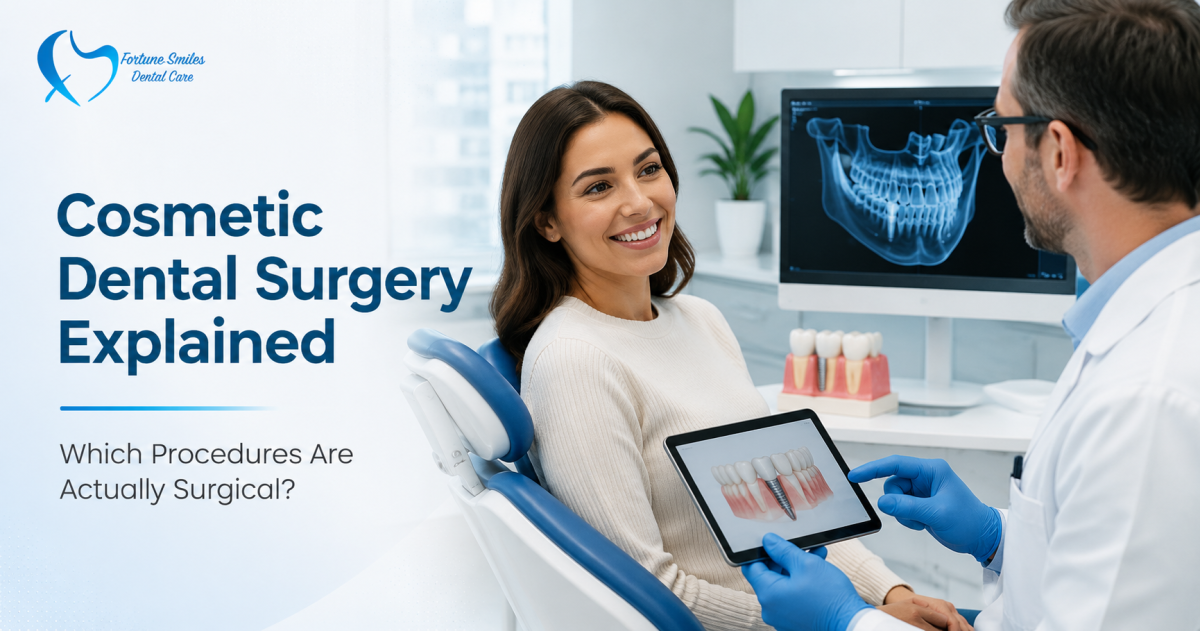
The phrase cosmetic dental surgery can be confusing because not every cosmetic dental treatment is actually surgery. Some smile-enhancing procedures involve reshaping, bonding, whitening, or aligning teeth without any surgical incision. Others, such as dental implants, gum surgery, bone grafting, or certain extractions, are surgical procedures because they involve the gums, bone, or deeper oral tissues.
If you are considering a smile makeover, it helps to understand the difference. A treatment may improve appearance, but that does not automatically mean it is surgical. At Fortune Smiles Dental Care, treatment planning focuses on choosing the right option for your teeth, gums, bite, health, comfort, and cosmetic goals.
This guide explains which cosmetic dental procedures are surgical, which are usually non-surgical, when surgery may be part of a cosmetic plan, and what patients should ask before treatment.
Quick Answer: What Counts as Cosmetic Dental Surgery?
A cosmetic dental procedure is usually considered surgical when it involves cutting, removing, reshaping, grafting, or placing something into the gums, jawbone, or oral tissues. Dental implant placement, bone grafting, gum grafting, crown lengthening, some tooth extractions, and some periodontal procedures are examples of dental surgeries that may also improve smile appearance.
Treatments like teeth whitening, dental bonding, Invisalign, and many veneer cases are cosmetic, but they are usually not oral surgery.
Why the Term “Cosmetic Dental Surgery” Is Often Misused
Many patients use the term cosmetic dental surgery to describe any major smile improvement. In everyday conversation, that makes sense. A dramatic smile transformation can feel like a surgical-level change, even if the procedure itself is not surgical.
In dentistry, however, the word “surgery” has a more specific meaning. It usually refers to treatment involving oral tissues, such as gum tissue or jawbone. That is different from treatments performed only on the surface of teeth, such as whitening, bonding, or polishing.
If you are exploring smile enhancement options, start with a broad overview of cosmetic dentistry so you can compare non-surgical and surgical approaches before choosing a plan.
Cosmetic Dental Procedures: Surgical vs. Non-Surgical
| Procedure | Usually Surgical? | Why It Matters |
|---|---|---|
| Teeth whitening | No | Changes tooth shade without cutting gum or bone tissue. |
| Dental bonding | No | Composite resin is shaped on the tooth surface. |
| Veneers | Usually no | Most veneer cases involve enamel preparation, not oral surgery. |
| Invisalign | No | Clear aligners move teeth gradually without surgery. |
| Dental implants | Yes | Implants are surgically placed into the jawbone. |
| Bone grafting | Yes | Bone material is added to rebuild support for implants or oral structure. |
| Gum contouring or crown lengthening | Sometimes yes | May involve reshaping gum tissue and sometimes bone. |
| Tooth extraction before cosmetic treatment | Yes | Removing a tooth is an oral surgery procedure. |
Dental Implants: A Cosmetic and Surgical Procedure
Dental implants are one of the clearest examples of cosmetic dental surgery. They can improve the appearance of a smile by replacing missing teeth, but the implant itself is surgically placed into the jawbone. After healing, the implant can support a crown, bridge, or denture.
Implant treatment may involve several stages, including removing a damaged tooth, preparing the jawbone, placing the implant, allowing healing time, attaching an abutment, and restoring the visible tooth. In some cases, bone grafting is needed before or during implant treatment.
Patients missing one or more teeth can learn more about implant dentistry and how it supports both function and appearance.
Bone Grafting: Surgical Support for a Better Smile
Bone grafting is not usually thought of as a cosmetic procedure by itself, but it can be an important part of a cosmetic dental plan. If a patient has lost bone after tooth loss, gum disease, trauma, or long-term denture use, there may not be enough support for a dental implant.
A bone graft helps rebuild the jawbone so an implant can be placed in a healthier, more stable position. This can affect not only chewing function but also facial support and the final appearance of the restored smile.
Because bone grafting involves oral tissues and healing time, it is considered a surgical procedure.
Gum Contouring and Crown Lengthening
Some patients feel their smile looks “gummy,” uneven, or unbalanced because too much gum tissue covers the teeth. Gum contouring may reshape the gumline to create a more even smile. In simple cases, only soft tissue may be adjusted. In more advanced cases, bone reshaping may also be required.
Crown lengthening is a related procedure that exposes more of the natural tooth structure. It may be done for cosmetic reasons, restorative reasons, or both. For example, a patient may need crown lengthening before a crown or veneer can be placed correctly.
Since these treatments may involve reshaping gum tissue and sometimes bone, they can fall under surgical dentistry depending on the case.
Tooth Extractions Before Cosmetic Treatment
Tooth extraction is not cosmetic by itself, but it may be part of a cosmetic or restorative plan when a tooth cannot be saved. For example, a badly damaged tooth may need to be removed before an implant-supported crown is placed.
Extractions can range from straightforward to more complex. Some teeth are removed simply, while others require surgical techniques, especially if they are broken, impacted, or difficult to access.
Fortune Smiles Dental Care includes extractions as part of broader general dentistry services when a tooth cannot be preserved safely.
Which Cosmetic Dental Procedures Are Usually Not Surgical?
Many popular cosmetic dental treatments can improve the smile without oral surgery. These options are often appropriate when the teeth and gums are healthy and the concern is mostly color, shape, spacing, or mild alignment.
- Teeth whitening: brightens natural teeth without changing tooth shape.
- Dental bonding: repairs chips, small gaps, and uneven edges with tooth-colored resin.
- Porcelain veneers: cover the front surfaces of teeth; usually not surgery, though enamel may be prepared.
- Invisalign: moves teeth with clear aligners, often before bonding or veneers.
- Tooth reshaping: gently smooths small irregularities in tooth edges.
Veneers: Cosmetic, but Usually Not Surgery
Veneers are often associated with dramatic smile transformations, but they are usually not considered oral surgery. A veneer is a thin shell placed over the front surface of a tooth to improve color, shape, size, or symmetry.
Some enamel may be removed to prepare the tooth, especially for porcelain veneers. That makes veneers irreversible in many cases, but enamel preparation is different from gum or jaw surgery.
If you are comparing veneers with other cosmetic options, this guide to dental veneers explains when they may be the right choice.
Bonding and Whitening: Cosmetic Without Surgery
Dental bonding and whitening are two common non-surgical cosmetic options. Bonding uses tooth-colored composite resin to repair small chips, close minor gaps, or improve tooth shape. Whitening lightens natural tooth color when stains respond to bleaching agents.
These treatments can be helpful for patients who want a conservative smile improvement without surgical treatment. However, they have limits. Bonding is not as stain-resistant as porcelain, and whitening does not change the color of crowns, fillings, or veneers.
For patients interested in conservative cosmetic improvements, composite bonding may be a good place to start.
Invisalign Before Cosmetic Dental Work
Invisalign is not surgery, but it can play an important role in a cosmetic dental plan. If teeth are crowded, rotated, or unevenly spaced, moving them first may allow for more conservative bonding or veneers later.
For example, placing veneers on crowded teeth may require more tooth preparation. If the teeth are aligned first, the final cosmetic work may look more natural and require less alteration of healthy tooth structure.
Patients who want straighter teeth without traditional braces can learn more about Invisalign in San Jose.
When Surgery Becomes Part of a Smile Makeover
A smile makeover may include both surgical and non-surgical treatments. One patient may only need whitening and bonding. Another may need gum treatment, implant placement, bone grafting, crowns, and veneers.
Surgery becomes part of the plan when appearance is connected to deeper oral health needs. Missing teeth, severe gum recession, bone loss, unsalvageable teeth, infected teeth, or an uneven gumline may require surgical care before the cosmetic result can be stable and healthy.
That is why a complete exam matters. Cosmetic treatment should not focus only on the visible front teeth. The dentist also needs to evaluate gum health, bite function, bone support, tooth structure, and long-term maintenance.
Questions to Ask Before Cosmetic Dental Surgery
Is this procedure truly surgical?
Ask whether gum tissue, bone, or oral tissues will be cut, reshaped, grafted, or implanted.
What are the alternatives?
Some cosmetic goals can be achieved with bonding, whitening, veneers, or Invisalign instead of surgery.
What is the healing time?
Implants, grafting, extractions, and gum surgery may require recovery time and follow-up visits.
Will this improve health, appearance, or both?
Some procedures are cosmetic, some are medically necessary, and many are a combination of both.
Considering Cosmetic Dental Surgery?
Whether you need a non-surgical cosmetic treatment or a more advanced surgical plan, Fortune Smiles Dental Care can help you understand your options and choose a treatment path that supports both beauty and oral health.
Frequently Asked Questions
Is cosmetic dentistry the same as cosmetic dental surgery?
No. Cosmetic dentistry includes many non-surgical treatments, such as whitening, bonding, veneers, and Invisalign. Cosmetic dental surgery refers to procedures that involve oral tissues, gums, or jawbone.
Are dental implants considered surgery?
Yes. Dental implants are surgically placed into the jawbone and require healing before the final restoration is completed.
Are veneers surgical?
Veneers are usually not considered surgery. They may require enamel preparation, but they typically do not involve surgery on gum tissue or jawbone.
Is gum contouring surgical?
Sometimes. Simple soft-tissue contouring may be minor, but crown lengthening or gum reshaping that involves bone is considered surgical.
Can a smile makeover include surgery?
Yes. A smile makeover may include non-surgical treatments like whitening and bonding, or surgical procedures like implants, grafting, extractions, or gum surgery when needed.
Disclaimer: This article is for general educational purposes only and does not replace a dental examination, diagnosis, or personalized treatment plan. Surgical and cosmetic recommendations vary by patient.