
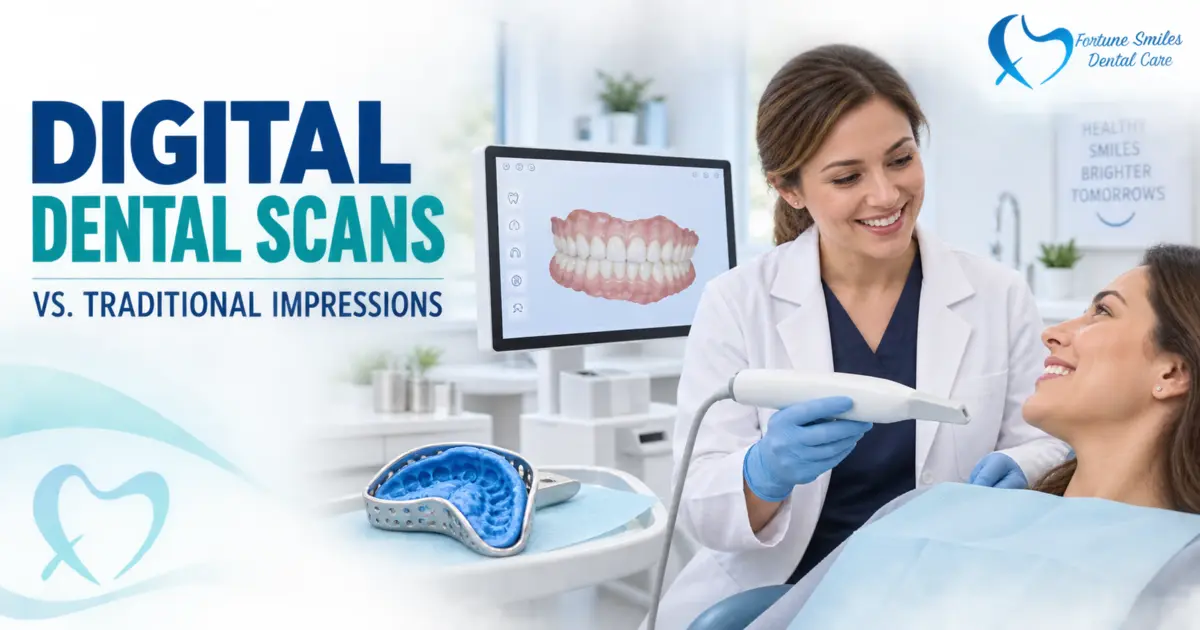
If you have ever needed a crown, clear aligners, a retainer, a mouthguard, or another custom dental appliance, your dentist may have needed an accurate model of your teeth. Traditionally, this meant placing soft impression material inside a tray and holding it over your teeth until the material hardened. Today, many dental offices can create the same type of record with a handheld digital dental scanner.
Digital dental scans create a detailed three-dimensional model of your teeth and gums without filling your mouth with impression material. For many patients, the process feels faster, cleaner, and more comfortable. The digital model can also be viewed immediately and securely sent to a dental laboratory or used with treatment-planning software.
That does not mean traditional impressions are obsolete. Each method has strengths and limitations, and the best option depends on the treatment, the condition of your teeth and gums, and the clinical detail your dentist needs to capture. This guide explains how both methods work and what patients can expect from each one.
Quick Answer: Are Digital Dental Scans Better?
For many crowns, bridges, clear aligners, retainers, nightguards, and other routine treatments, digital scans can provide an accurate and comfortable alternative to traditional impressions. Patients often prefer scanning because there is no tray filled with impression material and the dentist can review the model immediately.
However, conventional impressions may still be recommended when the dentist needs to capture difficult areas below the gumline, movable soft tissues, a fully toothless arch, or certain complex implant arrangements. The better method is the one that produces the most reliable information for your specific treatment.
What Is a Digital Dental Scan?
A digital dental scan, also called an intraoral scan or digital impression, is created with a small handheld scanning wand. The dental professional moves the scanner over the surfaces of your teeth and gums while specialized software combines thousands of images into a three-dimensional model.
The developing model appears on a computer screen during the appointment. The dentist can rotate it, enlarge individual areas, examine the bite, and check whether all necessary surfaces have been recorded. If part of the scan is incomplete, that area can often be rescanned without repeating the entire process.
An intraoral scanner normally uses optical imaging rather than ionizing radiation. It is therefore different from a dental X-ray. The scan records the visible shape and position of teeth and gums, while X-rays help show structures that cannot be seen directly, including tooth roots, bone, and areas between teeth.
What Is a Traditional Dental Impression?
A traditional impression uses a tray filled with a soft dental material. The tray is positioned over the upper or lower teeth and remains in place while the material sets. Once removed, the impression contains a negative copy of the teeth and surrounding tissues.
A dental laboratory may pour stone into the impression to produce a physical model. That model can then be used to design a crown, bridge, denture, retainer, mouthguard, or another custom restoration or appliance.
Conventional impressions have been used successfully for decades. When the correct material, tray, and technique are selected, they can capture highly detailed information. Their main disadvantages for patients are the size of the tray, the taste and texture of the material, and the possibility of triggering a gag reflex.
Digital Scans vs. Traditional Impressions at a Glance
| Comparison | Digital Dental Scan | Traditional Impression |
|---|---|---|
| How it works | A handheld scanner creates a 3D computer model. | Material in a tray creates a physical mold. |
| Patient comfort | Usually more comfortable, especially for patients with a strong gag reflex. | May feel bulky or trigger gagging in some patients. |
| Review process | The dentist can inspect the model immediately. | Defects may not become apparent until the impression or model is inspected. |
| Corrections | A missing area can often be rescanned. | The full impression may need to be repeated. |
| Transfer to laboratory | The digital file can be transmitted electronically. | The physical impression may need packaging and delivery. |
| Best applications | Many crowns, bridges, aligners, retainers, guards, and selected implant cases. | Complex tissue recording, some dentures, deep margins, and selected implant cases. |
| Radiation | An optical intraoral scan does not normally use ionizing radiation. | No radiation is used. |
Which Method Is More Comfortable?
Comfort is one of the clearest advantages of digital scanning. The scanner wand still needs to move around the mouth, but it does not require a large tray filled with setting material. Patients can usually close their mouth briefly when the dental professional pauses, and the scan can be stopped if they need a break.
This may be especially helpful for people with a sensitive gag reflex, dental anxiety, breathing concerns, or discomfort when impression material touches the palate. Digital scanning also avoids the taste, smell, and texture that some patients dislike about conventional materials.
The scanner is not completely sensation-free. Patients with a small mouth, limited opening, tender gums, or sensitive teeth may still experience mild discomfort. However, clinical research generally reports greater patient preference and comfort with digital impressions.
What Does an Intraoral Scan Feel Like?
- A smooth scanning wand is moved slowly around the teeth.
- You may be asked to turn your head or open slightly wider for back teeth.
- The dental professional may use air or suction to keep surfaces dry.
- You can normally breathe throughout the procedure.
- The scan can usually be paused when you need a short break.
- You may be able to watch the 3D model appear on the screen.
Are Digital Dental Scans More Accurate?
Digital scans can be highly accurate, but it would be misleading to say they are always more accurate than traditional impressions. Accuracy depends on the scanner, calibration, software, scanning technique, moisture control, tooth preparation, and length of the area being recorded.
For many single crowns and short-span restorations, digital scanning can produce clinically suitable results. It also allows the dentist to enlarge the preparation on screen and check whether important areas have been captured before the patient leaves.
Longer scans can be more challenging because small alignment errors may accumulate as the software combines images across the arch. Complex full-arch implant cases can require additional verification or another impression method. The dentist should select the workflow that provides sufficient accuracy for the planned restoration.
If you are preparing for a restoration, our guide to dental crown materials explains how the type and location of a crown can influence treatment planning.
When Are Digital Dental Scans Used?
Intraoral scanners can support several restorative, orthodontic, preventive, and cosmetic treatments. Common applications include:
Crowns and Bridges
A scan can record a prepared tooth, nearby teeth, the opposing arch, and the patient’s bite for laboratory design.
Clear Aligners
A full digital model can help plan tooth movement and produce a series of custom aligners.
Retainers and Guards
Digital models may be used to fabricate retainers, whitening trays, sports guards, and nightguards.
Dental Implants
Scanners can record implant positions in selected cases using special components called scan bodies.
Smile Planning
The scan may help patients and dentists evaluate tooth shape, spacing, alignment, and possible cosmetic changes.
Monitoring Changes
Scans taken at different appointments may help document changes in tooth position, wear, or gum contours.
Patients considering clear aligners can also review our guide to affordable Invisalign in San Jose to learn how digital planning may fit into orthodontic treatment.
When Might a Traditional Impression Be Better?
Digital scanning is useful, but it is not automatically the best choice in every situation. Optical scanners must be able to clearly see the surface they are recording. Blood, saliva, deep preparation margins, and tissue covering part of a tooth can make scanning more difficult.
Traditional materials can sometimes record areas that are difficult for a camera to visualize. They may also be useful when the dentist needs to capture movable gum and muscle tissues for a complete denture or when a particular dental laboratory requires a conventional workflow.
A conventional or combined approach may be considered when:
- A crown margin extends deeply below the gumline.
- Bleeding or moisture prevents the scanner from seeing the surface clearly.
- Movable soft tissues must be recorded under functional pressure.
- The patient has no remaining teeth and needs a complete denture.
- A complex full-arch implant restoration is being planned.
- The dentist or laboratory determines that a conventional technique will produce a more predictable result.
Which Patients May Benefit Most From Digital Scanning?
| Patient or Situation | Potential Benefit | Important Consideration |
|---|---|---|
| Strong gag reflex | Avoids a tray filled with impression material. | The wand must still reach the back teeth. |
| Dental anxiety | The process can be paused and explained on screen. | Tell the dental team about triggers before scanning. |
| Clear aligner patient | Creates a full 3D model for digital treatment planning. | A complete clinical and bite evaluation is still necessary. |
| Single crown patient | The preparation can be reviewed before the file is submitted. | The tooth and gumline must remain visible and dry. |
| Monitoring tooth wear | Digital models can be compared over time. | Comparison quality depends on consistent scans and software. |
Can Digital Scanning Make Treatment Faster?
A digital workflow may reduce certain steps. The dentist can check the scan immediately, and the completed file can be transferred electronically instead of shipping a physical impression. A laboratory can then begin reviewing or designing the restoration without waiting for a package to arrive.
Digital delivery does not guarantee that the final crown, aligner, or appliance will be ready the same day. Treatment time also depends on the laboratory, restoration type, material, case complexity, appointment schedule, and whether adjustments are needed.
The main advantage is a more direct flow of information. Faster communication between the dentist and laboratory may help identify concerns sooner and reduce delays caused by damaged, distorted, or incomplete physical impressions.
Do Digital Scans Improve Crown Fit?
The fit of a crown depends on much more than the impression method. Tooth preparation, gum management, moisture control, scan or impression quality, laboratory design, manufacturing accuracy, crown material, bite adjustment, and cementation all affect the final result.
Digital scanning can help because the dentist can inspect preparation margins and identify missing information before sending the case. Some software also highlights areas that may need additional reduction or may not provide enough clearance for the planned material.
A digital scan cannot correct an unclear margin, active bleeding, decay, or an unsuitable tooth preparation. Clinical judgment remains the most important part of creating a well-fitting restoration.
How Are Digital Scans Used for Dental Implants?
In selected implant cases, a dentist can attach a scan body to the implant. The scanner records its shape and position, and the software uses that information to determine the implant’s orientation for restoration design.
Digital implant impressions can work well for single implants and some short-span restorations. Fully edentulous arches with several implants are more technically demanding because the scanner must accurately connect multiple separate scan bodies across a long distance.
Complex cases may require a conventional impression, photogrammetry, verification device, or combination of techniques. Patients considering replacement of a missing tooth can read our dental implants guide for an overview of implant treatment and planning.
Are Digital Dental Scans Safe?
An intraoral scan is generally considered noninvasive. The scanner records surface information with optical imaging and does not normally expose the patient to ionizing radiation. It does not cut, drill, or permanently change the teeth.
The scanning wand should be cleaned and protected according to the manufacturer’s infection-control instructions. As with other dental records, digital scan files contain health information and should be stored and transmitted using appropriate privacy and security safeguards.
Digital scans do not replace dental X-rays, examinations, or other diagnostic tests. A scan shows visible surface shape, but it cannot independently diagnose cavities inside teeth, infections around roots, or bone loss hidden below the gums.
How Much Does a Digital Dental Scan Cost?
The cost of scanning varies between dental offices and treatments. In many cases, the scan is included in the overall fee for a crown, aligner, retainer, implant restoration, or other appliance rather than billed as a separate procedure.
Insurance coverage depends on the treatment being provided and the patient’s plan. The fact that a digital scanner is used does not necessarily mean the treatment will cost more or be covered differently.
Before starting treatment, ask for an estimate that explains the procedure, laboratory charges, insurance estimate, and expected out-of-pocket cost. The clinical suitability of the impression method should remain more important than choosing solely on price.
Questions to Ask Before Your Impression
- Will my case use a digital scan or a traditional impression?
- Why is that method the better option for this treatment?
- What should I expect during the appointment?
- Can the procedure be paused if I feel uncomfortable?
- Will another impression be needed later?
- How will the scan or impression be used by the dental laboratory?
Digital Scan or Traditional Impression: How Does Your Dentist Decide?
Your dentist considers the treatment type, number of teeth involved, tooth position, condition of the gums, location of restoration margins, presence of implants, ability to control moisture, laboratory requirements, and available technology.
In some appointments, both methods may be used. For example, a digital scan may record the teeth while another material records a specific soft-tissue area. A hybrid workflow is not a sign that one method failed; it may be the most reliable way to collect all necessary information.
Routine examinations also help dentists identify problems before complex restorative work becomes necessary. Learn why regular dental checkups remain important even when advanced digital technology is available.
The Bottom Line
Digital dental scans offer a comfortable and efficient way to create detailed three-dimensional models of the teeth. They are particularly useful for many crowns, clear aligners, retainers, mouthguards, and selected implant restorations.
Traditional impressions remain valuable. They may provide a more predictable record in certain complex cases, especially when deep margins, movable tissues, complete dentures, or extensive implant treatment are involved.
For patients, the important question is not whether the newest method is always better. It is whether the chosen technique can capture the information needed to produce a comfortable, functional, and accurately fitting restoration or appliance.
Need a Crown, Aligner, Retainer, or Custom Dental Appliance?
Fortune Smiles Dental Care can examine your teeth, explain whether a digital scan or traditional impression is appropriate, and create a treatment plan based on your comfort and clinical needs.
Frequently Asked Questions
Does a digital dental scan hurt?
Digital scanning should not be painful. You may feel light pressure as the wand moves around your teeth, especially near the back of the mouth. Tell the dental professional if an area feels sensitive or you need a break.
How long does an intraoral scan take?
Scan time depends on whether one tooth, part of the mouth, or both full arches are needed. Case complexity, moisture, patient movement, and the need to rescan individual areas can also affect the appointment time.
Are digital scans better for patients with a gag reflex?
Many patients with a sensitive gag reflex find digital scanning easier because it avoids a tray filled with impression material. The scanner must still reach the back teeth, but the procedure can normally be paused as needed.
Do digital dental scans use radiation?
Standard intraoral scanners use optical imaging and do not normally produce ionizing radiation. They are different from dental X-rays and 3D cone-beam scans, which may still be needed for diagnosis or treatment planning.
Can a digital scan detect cavities?
A surface scan may show visible changes in tooth shape, but it cannot reliably detect every cavity, especially decay between teeth or beneath existing restorations. Dentists diagnose cavities using an examination and, when appropriate, dental X-rays and other diagnostic tools.
Can digital impressions be used for dentures?
Digital scanning may be used in some denture workflows, particularly when teeth or an existing denture provide reference points. Fully toothless arches and movable soft tissues can be more difficult to capture, so a traditional or combined impression may be recommended.
Will digital scans completely replace traditional impressions?
Digital scanning will likely continue to become more common, but conventional impressions remain useful for specific clinical situations. Dentists may continue using both methods based on the requirements of each patient and treatment.
Disclaimer: This article provides general educational information and is not a substitute for a dental examination, diagnosis, or personalized treatment recommendation. The appropriate impression technique depends on the individual patient and procedure.