
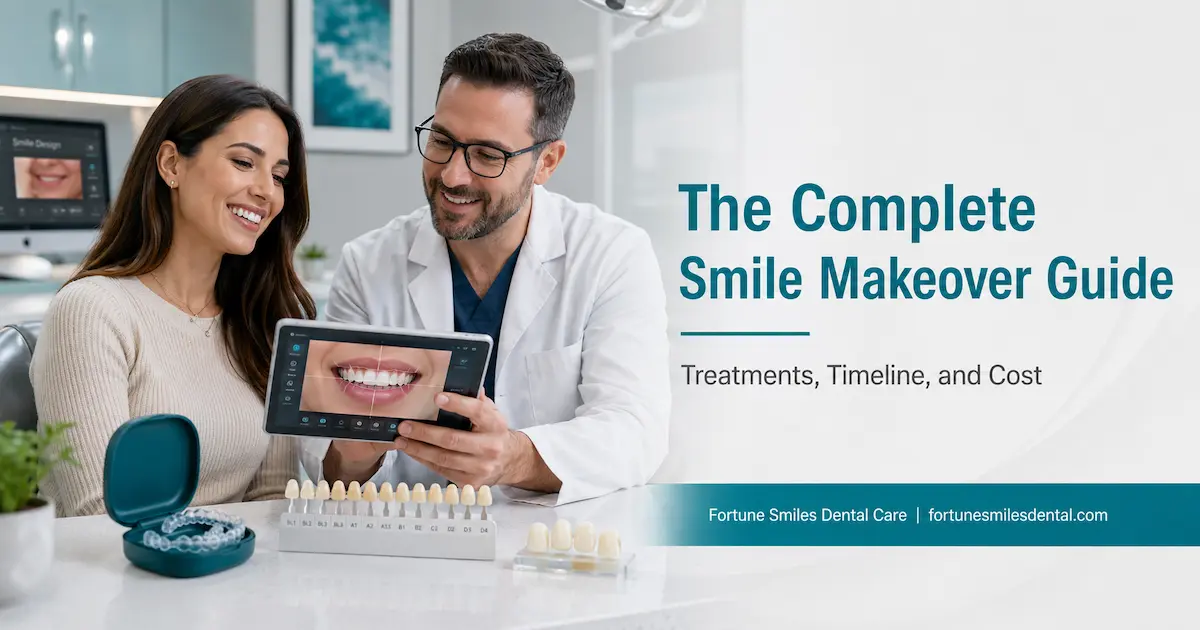
A smile makeover is a personalized plan that improves the appearance of your smile while supporting healthy teeth, gums, and bite function. It can be as simple as whitening and bonding or as comprehensive as veneers, Invisalign, crowns, gum contouring, and restorative care combined into one coordinated treatment plan.
The best smile makeovers are not designed around a “perfect” template. They are planned around your face, tooth shape, gum line, bite, age, lifestyle, and long-term dental health. A natural-looking result should make your smile brighter, more balanced, and more confident without making it look artificial.
This guide explains the most common smile makeover treatments, how long the process usually takes, what affects the cost, and how to decide which cosmetic dentistry options may be right for you.
Quick Answer: What Is a Smile Makeover?
A smile makeover is a custom cosmetic dentistry plan that may include teeth whitening, dental bonding, porcelain veneers, Invisalign, crowns, implants, or gum reshaping. The goal is to improve smile color, shape, alignment, symmetry, and overall appearance while keeping the teeth healthy and functional.
- Best for: stained, chipped, worn, uneven, crowded, spaced, or aging teeth
- Common treatments: whitening, bonding, veneers, Invisalign, crowns, implants, and gum contouring
- Typical timeline: one visit to several months, depending on treatment complexity
- Cost range: a few hundred dollars for minor improvements to several thousand dollars for a full smile transformation
Who Is a Good Candidate for a Smile Makeover?
You may be a good candidate for a smile makeover if you are unhappy with the way your teeth look and want a personalized plan rather than a single isolated treatment. Smile makeovers are often chosen by patients who feel self-conscious about discoloration, chips, uneven edges, small gaps, worn teeth, old dental work, or a smile that looks aged.
However, cosmetic dentistry should begin with oral health. If you have gum disease, active cavities, untreated infections, unstable bite problems, or severe tooth grinding, those issues should be addressed before cosmetic work begins. Placing veneers, crowns, or bonding over unhealthy teeth can lead to poor results and future complications.
A good consultation should evaluate both beauty and function. The dentist should look at your teeth, gums, jaw relationship, facial proportions, tooth wear, and existing restorations before recommending a treatment plan.
Smile Makeover Treatments Compared
| Treatment | What It Improves | Typical Timeline | Best For |
|---|---|---|---|
| Teeth whitening | Yellowing and surface stains | One visit or take-home system | Patients happy with tooth shape but wanting a brighter smile |
| Dental bonding | Small chips, gaps, and uneven edges | Often one visit | Conservative cosmetic corrections |
| Porcelain veneers | Color, shape, size, spacing, and symmetry | Usually 2 to 4 visits | Comprehensive front-tooth smile changes |
| Invisalign | Crowding, gaps, rotations, and alignment | Several months or longer | Patients who want straighter teeth before cosmetic work |
| Dental crowns | Damaged, weakened, or heavily restored teeth | Usually 2 visits | Teeth needing strength and cosmetic improvement |
| Dental implants | Missing teeth | Several months in many cases | Replacing missing teeth with a long-term solution |
Many smile makeover plans combine two or more treatments. For example, whitening may be completed before bonding so the bonding shade matches the brighter teeth. Invisalign may be recommended before veneers to improve tooth position and reduce the need for more aggressive tooth preparation.
Step 1: Smile Makeover Consultation and Digital Planning
The first step is a detailed consultation. Your dentist should ask what you want to change, whether you prefer a subtle or dramatic result, and what concerns matter most to you. Some patients want whiter teeth. Others want a fuller smile, straighter front teeth, a more even gum line, or replacement of old dental work.
The clinical exam may include photographs, digital scans, X-rays, gum evaluation, bite analysis, and a review of existing fillings, crowns, veneers, or implants. This helps the dentist understand what is cosmetically possible and what needs to be treated first for health or function.
Patients considering a full transformation can start with a professional smile makeover consultation to compare treatment options and understand the best sequence for their case.
Step 2: Teeth Whitening for a Brighter Foundation
Teeth whitening is often the simplest first step in a smile makeover. It can brighten natural teeth and help establish the shade for later treatments such as bonding, veneers, or crowns. Whitening is especially useful when the main concern is yellowing from coffee, tea, wine, aging, or surface staining.
It is important to understand that whitening only changes the color of natural tooth structure. It does not whiten porcelain veneers, crowns, bonding, fillings, or implants. The American Dental Association notes that patients with tooth-colored restorations should know that bleaching may create a color difference because restorations do not lighten the same way natural teeth do.
For this reason, whitening should be planned before new cosmetic restorations are matched to your final desired shade.
Step 3: Dental Bonding for Small Cosmetic Corrections
Dental bonding uses tooth-colored composite resin to repair small chips, close minor gaps, smooth uneven edges, and improve tooth shape. It is one of the most conservative cosmetic dentistry options because it usually requires little or no enamel removal.
Bonding can be a smart choice for patients who want an affordable improvement without committing to porcelain veneers. It can also be used after Invisalign to refine tooth shape once the teeth are better aligned.
The main limitation is durability. Composite bonding can stain, chip, or wear over time, especially for patients who grind their teeth, bite nails, chew ice, or drink dark beverages frequently.
Step 4: Porcelain Veneers for a Complete Smile Transformation
Porcelain veneers are thin, custom-made shells bonded to the front surfaces of teeth. They are often used when patients want to improve several cosmetic concerns at once, including deep discoloration, worn edges, uneven tooth shape, small gaps, mild misalignment, and asymmetry.
Veneers can create a major smile transformation, but they must be carefully planned. A natural result depends on tooth proportions, facial balance, gum line, smile width, and shade selection. Teeth that are too white, too square, or too bulky can look artificial, while well-designed veneers should enhance the face rather than dominate it.
If veneers are part of your plan, review the complete process in this guide to dental veneers.
Step 5: Invisalign Before Veneers or Bonding
Invisalign may be recommended before cosmetic restorations when teeth are crowded, rotated, or unevenly spaced. Moving the teeth first can make the final result more conservative, more stable, and more natural-looking.
For example, if front teeth are crowded, placing veneers without improving alignment may require more tooth reduction. If Invisalign is completed first, the dentist may be able to use less invasive bonding or thinner veneers. In some cases, Invisalign and whitening may be enough to achieve the patient’s goals.
Patients who want straighter teeth without traditional braces can learn more about Invisalign treatment.
Step 6: Crowns, Implants, and Restorative Care
Not every smile makeover is purely cosmetic. Some patients have old crowns, failing fillings, cracked teeth, missing teeth, or worn dental work that affects both appearance and function. In these cases, restorative dentistry may be part of the makeover plan.
Crowns can improve the appearance of teeth that are damaged or structurally weak. Dental implants may be recommended when one or more teeth are missing. Tooth-colored restorations can replace dark or worn fillings in visible areas.
A strong smile makeover plan should not ignore function. Cosmetic improvements look better and last longer when the bite is stable and the underlying teeth are healthy.
Smile Makeover Timeline: What to Expect
Consultation, exam, photos, scans, X-rays if needed, and discussion of goals.
Treatment options, sequencing, cost estimate, shade selection, and timeline review.
Whitening, gum treatment, Invisalign, or restorative care if needed before final cosmetic work.
Bonding, veneers, crowns, or final restorations are completed according to the plan.
Bite check, polishing, fit review, and any needed refinements.
Retainers, nightguards, cleanings, and long-term follow-up help protect the result.
How Much Does a Smile Makeover Cost?
Smile makeover cost varies widely because every plan is different. A minor makeover may include whitening and a few bonding repairs. A full makeover may involve 6 to 10 veneers, Invisalign, crowns, gum contouring, or implant treatment.
| Treatment | General Cost Range | What Affects Price |
|---|---|---|
| Professional whitening | Often a few hundred dollars | In-office vs. take-home system, whitening type, maintenance plan |
| Dental bonding | Usually priced per tooth | Number of teeth, size of repair, complexity, material used |
| Porcelain veneers | Commonly several hundred to several thousand dollars per tooth | Material, lab quality, number of veneers, design complexity |
| Invisalign | Usually several thousand dollars | Case complexity, treatment length, refinements, retainers |
| Crowns | Usually priced per tooth | Material, tooth condition, buildup needs, lab work |
| Full smile makeover | Can range from a few thousand to $20,000+ in complex cases | Treatment mix, number of teeth, bite needs, materials, and planning |
Because cosmetic treatment fees vary by location, dentist, materials, and case complexity, the most accurate way to understand cost is to request a written estimate after an exam and treatment plan.
What Affects the Cost of a Smile Makeover?
Two patients can receive very different smile makeover estimates because their needs may be completely different. One patient may only need whitening and bonding on two teeth. Another may need Invisalign, gum treatment, eight veneers, and replacement of old crowns.
- Number of teeth included in the smile zone
- Whether alignment treatment is needed first
- Material choice, such as composite vs. porcelain
- Condition of existing fillings, crowns, or veneers
- Need for gum treatment, implants, or restorative care
- Laboratory quality and customization level
- Use of digital scans, smile design, wax-ups, or temporary previews
- Whether retainers, nightguards, or follow-up visits are included
A lower price is not always the better value if it excludes important planning, quality materials, or maintenance. A clear quote should explain what is included and what may be billed separately.
Does Insurance Cover a Smile Makeover?
Dental insurance usually does not cover treatment that is purely cosmetic, such as elective whitening or veneers placed only to improve appearance. However, insurance may contribute to procedures that are medically necessary, such as crowns for damaged teeth or treatment related to decay, fracture, or missing teeth.
Coverage depends on your specific plan, annual maximum, deductible, waiting periods, exclusions, and whether the procedure is considered cosmetic or functional. Some treatments may have partial coverage, while others may be fully out of pocket.
Before starting treatment, ask for a written estimate and insurance benefits review so you understand your expected responsibility.
How to Choose the Right Smile Makeover Plan
The right plan depends on your goals, oral health, timeline, budget, and how much change you want. If your teeth are healthy but stained, whitening may be enough. If your teeth are chipped or slightly uneven, bonding may be appropriate. If you want a major change in color, shape, and symmetry, veneers may be a better fit.
If your teeth are crowded or your bite is not balanced, Invisalign may need to come first. If teeth are structurally damaged, crowns or restorative dentistry may be more appropriate than veneers.
A thoughtful dentist should explain the pros and cons of each option rather than pushing one treatment for every patient.
Ready to Plan Your Smile Makeover?
A beautiful smile should look natural, feel comfortable, and support long-term oral health. Fortune Smiles Dental Care can help you compare whitening, bonding, veneers, Invisalign, crowns, and full smile makeover options based on your goals.
Frequently Asked Questions
What is included in a smile makeover?
A smile makeover may include whitening, bonding, veneers, Invisalign, crowns, implants, gum contouring, or replacement of old dental work. The exact plan depends on your oral health and cosmetic goals.
How long does a smile makeover take?
A minor smile makeover may take one or two visits. A more complete plan involving Invisalign, veneers, crowns, implants, or gum treatment may take several months or longer.
How much does a full smile makeover cost?
Cost varies based on the treatments used, number of teeth, materials, case complexity, and whether restorative care is needed. A full smile makeover can range from a few thousand dollars to $20,000 or more in complex cases.
Are veneers required for a smile makeover?
No. Veneers are only one option. Some patients can achieve their goals with whitening, bonding, Invisalign, crowns, or a combination of more conservative treatments.
Is a smile makeover painful?
Most cosmetic dental treatments are designed to be comfortable. Some procedures may require local anesthesia, while others require little or none. Your dentist should explain what to expect before treatment begins.
How do I maintain my smile makeover?
Maintain your results with brushing, flossing, regular dental cleanings, retainers if recommended, a nightguard if you grind your teeth, and avoiding habits that can chip or stain cosmetic dental work.