
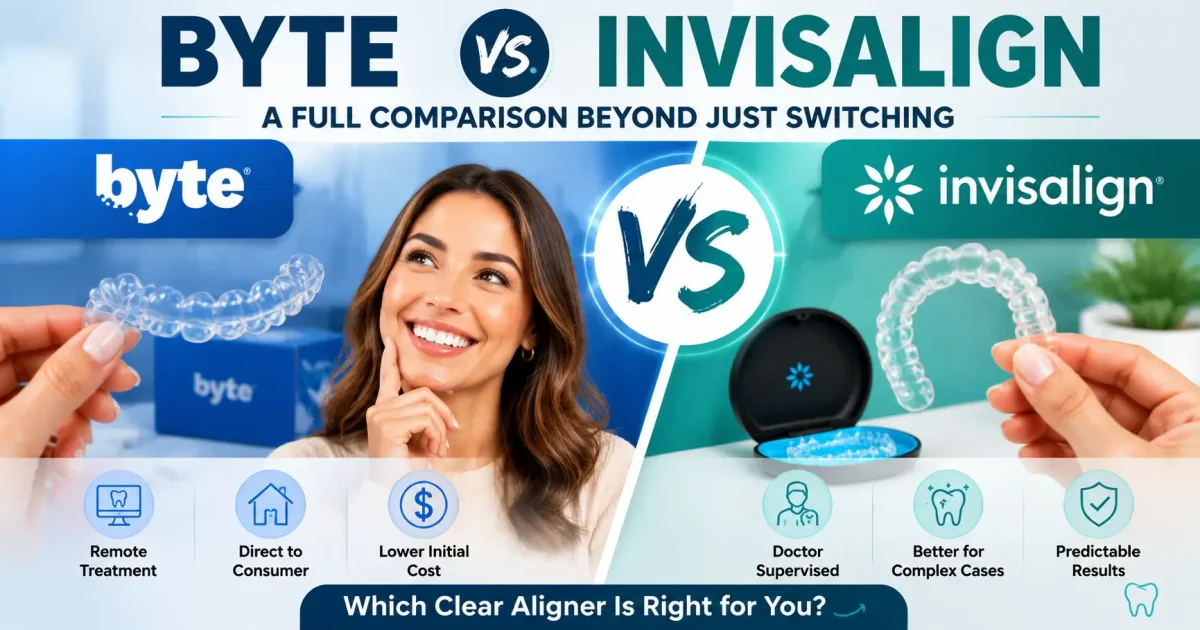
If you are comparing Byte vs Invisalign, the decision is about much more than choosing one clear aligner brand over another. It is about safety, professional supervision, treatment predictability, bite correction, refinements, and long-term smile stability.
Quick Answer
Invisalign is generally a stronger option for patients who need professional supervision, bite correction, attachments, refinements, and in-person care. Byte was known for remote clear aligner treatment, but patients with overbite, crowding, crossbite, open bite, or complex tooth movement often need the detailed monitoring that Invisalign can provide through a trained dental provider.
Clear aligners have changed the way adults and teens straighten their teeth. Instead of metal brackets and wires, patients can often improve their smile with nearly invisible removable trays. That convenience is one reason brands like Byte and Invisalign became so popular.
However, not all clear aligner treatment is the same. Some systems are designed for mild cosmetic movement. Others can handle more advanced orthodontic planning, bite correction, attachments, refinements, and long-term retention.
For patients in San Jose, including Blossom Valley, Alamitos, Robertsville, and areas near Westfield Oakridge, choosing between Byte and Invisalign should not be based only on price or convenience. It should be based on oral health, case complexity, treatment safety, and the quality of final results.
At Fortune Smiles Dental Care, Dr. Forutan helps patients understand whether Invisalign treatment is the right fit for their smile, bite, and long-term dental health.
Why People Compare Byte and Invisalign
Byte and Invisalign are often compared because both are clear aligner systems. Both are designed to move teeth gradually using custom trays. Both appeal to patients who want a more discreet alternative to traditional braces.
But the treatment experience can be very different.
Many people originally considered Byte because it was marketed as convenient, remote, and often less expensive than in-office orthodontic treatment. Invisalign, on the other hand, is typically provided through a licensed dentist or orthodontic provider who evaluates your teeth, gums, bite, and progress throughout treatment.
This difference matters because tooth movement is medical care. Moving teeth without proper diagnosis can create problems, especially if there are gum issues, bone loss, cavities, bite problems, or jaw-related concerns.
What Was Byte?
Byte was a direct-to-consumer clear aligner company that offered remote teeth straightening. Patients typically started with an at-home impression kit or scan, then received aligners by mail if approved for treatment.
The main appeal was convenience. Patients could begin treatment without frequent in-person appointments. This made Byte attractive to people with mild spacing or crowding who wanted a simple cosmetic improvement.
Byte was often associated with:
- Remote clear aligner treatment
- At-home impression kits
- Mail-order aligners
- Limited in-person monitoring
- Convenience-focused treatment
- Lower upfront pricing in some cases
However, remote aligner treatment has limitations. Not every patient is a good candidate for mail-order orthodontics, especially when bite correction, attachments, root movement, or complex alignment is needed.
Is Byte Still Available?
Many patients are now searching for a Byte alternative or asking whether they can switch from Byte to Invisalign. Because the status of direct-to-consumer aligner companies can change, patients should verify current availability directly through official sources before starting or continuing any treatment.
If you started with Byte or were considering Byte but now want a provider-supervised option, an Invisalign consultation is a smart next step. A dentist can evaluate whether your teeth have shifted properly, whether additional treatment is needed, and whether your bite is stable.
This is especially important if you stopped wearing aligners, did not finish treatment, lost retainers, or feel that your bite no longer fits correctly.
Thinking About Invisalign After Byte?
If you used Byte or considered remote aligners, a professional Invisalign evaluation can help determine whether your teeth, gums, and bite are healthy enough for continued clear aligner treatment.
How Invisalign Works
Invisalign is a clear aligner system designed to move teeth through a carefully planned sequence of custom trays. Treatment begins with a professional evaluation that may include digital scans, photos, X-rays, bite analysis, and a review of your dental health.
Unlike remote-only aligner models, Invisalign treatment is guided by a trained dental provider. This allows the dentist to monitor tooth movement, make adjustments, check gum health, evaluate bite changes, and recommend refinements when needed.
Invisalign may include:
- Digital scans instead of messy impressions
- Customized treatment planning
- Tooth-colored attachments for better control
- Elastics when bite correction is needed
- Refinements to improve final results
- Professional monitoring throughout treatment
- Custom retainers after treatment
This makes Invisalign a more flexible solution for patients with mild, moderate, and certain complex orthodontic needs.
Byte vs Invisalign Comparison Table
| Feature | Byte | Invisalign |
|---|---|---|
| Treatment model | Remote clear aligners | Provider-supervised clear aligners |
| In-person evaluation | Limited or not standard | Yes, through a dentist or orthodontic provider |
| Best for | Mild cosmetic cases | Mild to moderate and some complex cases |
| Bite correction | Limited | Often possible with proper planning |
| Attachments | Typically not comparable to Invisalign attachment planning | Available for controlled tooth movement |
| Refinements | May be limited depending on plan | Common when needed to improve final results |
| Monitoring | Remote monitoring | Professional follow-up and progress checks |
| Retainers | Usually separate or plan-dependent | Custom retention planning available |
| Long-term support | Limited compared with local provider care | Ongoing local dental support |
Treatment Quality Comparison
The biggest difference between Byte and Invisalign is not simply the plastic tray. It is the planning and monitoring behind the tray.
Clear aligners need to move teeth in a controlled and biologically safe way. That means your provider must consider tooth roots, bone support, gum health, bite forces, and how upper and lower teeth fit together.
Invisalign may offer better predictability for cases that require:
- Rotating teeth
- Moving roots more precisely
- Closing larger gaps
- Correcting crowding
- Improving overbite
- Managing crossbite or open bite
- Finishing the bite properly
Remote aligner treatment may work for very mild cases, but complex movement often requires in-person evaluation and closer supervision.
Doctor-Supervised Care
Invisalign treatment is monitored by a dental provider who can check progress, comfort, bite changes, and oral health.
Better for Bite Problems
Invisalign may be more appropriate for overbite, crowding, crossbite, and cases that need attachments or elastics.
Long-Term Retention
After treatment, custom retention planning helps protect your new smile and reduce the risk of relapse.
Byte vs Invisalign at a Glance
Signs Invisalign May Be the Better Choice
Part 1 ends here. Continue with Part 2 for cost comparison, complex cases, professional monitoring, CTA, FAQ, and schema.
Which One Is Better for Mild Cases?
If your primary concern is a small gap, minor crowding, or slight tooth rotation, both Byte and Invisalign were designed with mild orthodontic cases in mind. However, there is an important distinction.
Invisalign treatment begins with a comprehensive dental examination. Before any tooth movement starts, your provider evaluates your gums, bone support, bite relationship, existing restorations, and overall oral health. This helps reduce the risk of moving teeth that may already have underlying dental problems.
For patients with mild cosmetic concerns, Invisalign offers several advantages:
- Professional diagnosis before treatment
- Digital treatment simulation
- Continuous monitoring throughout treatment
- Adjustments if teeth are not tracking correctly
- Refinements to improve the final result
Many mild cases finish smoothly with Invisalign, while also giving patients confidence that their oral health is being monitored throughout the process.
Which One Is Better for Complex Cases?
The difference between Byte and Invisalign becomes much more noticeable when treating moderate or complex orthodontic problems.
Conditions such as:
- Overbite
- Crossbite
- Open bite
- Deep bite
- Severe crowding
- Large spacing
- Rotated teeth
often require advanced treatment planning. Invisalign allows providers to use precision attachments, elastics, staged tooth movement, and refinements to achieve more predictable results.
If you have an overbite, you may also find our guide on
Can Invisalign Fix an Overbite?
helpful before making your decision.
Why Case Selection Matters
Clear aligners are not simply cosmetic trays—they move living teeth through bone. The more complex the tooth movement, the more valuable professional diagnosis, monitoring, and treatment adjustments become.
Cost Comparison: Looking Beyond the Initial Price
Many patients initially compare Byte and Invisalign based on cost alone. While price is important, it should not be the only deciding factor.
The total value of orthodontic treatment includes much more than the aligners themselves.
- Initial examination
- Digital scans
- Treatment planning
- Professional supervision
- Progress appointments
- Refinements
- Retention planning
- Long-term support
Choosing treatment based solely on the lowest upfront price can sometimes lead to additional expenses later if retreatment or correction becomes necessary.
Why Professional Monitoring Matters
Professional supervision is one of the biggest advantages of Invisalign.
During treatment, your provider can identify issues before they become larger problems.
Regular monitoring allows your dentist to evaluate:
- Tooth movement
- Bite changes
- Tracking of aligners
- Gum health
- Bone support
- Oral hygiene
- Need for refinements
If something is not progressing as planned, adjustments can often be made before treatment is affected.
Benefits of Professional Invisalign Monitoring
Who Is Invisalign Best For?
Invisalign is an excellent option for patients who want a discreet orthodontic solution while benefiting from professional supervision.
You may be a strong candidate if you:
- Want nearly invisible aligners
- Have mild or moderate crowding
- Need bite correction
- Have spacing between teeth
- Want predictable treatment planning
- Prefer local follow-up appointments
- Are committed to wearing aligners consistently
After treatment, maintaining your new smile is equally important. Learn more in our guide to
Invisalign retainers after treatment.
Why Patients Choose Fortune Smiles Dental Care
At Fortune Smiles Dental Care, every Invisalign treatment plan is customized rather than standardized.
Led by Dr. Forutan, our team combines advanced digital technology with conservative, patient-centered dentistry to create healthy, functional, and natural-looking smiles.
Patients appreciate that treatment begins with understanding the whole person—not just crooked teeth. Every consultation considers oral health, bite function, facial harmony, long-term stability, and the patient’s personal goals.
We proudly care for patients throughout San Jose, including Blossom Valley, Alamitos, Robertsville, and neighborhoods surrounding Westfield Oakridge.
Thinking About Switching to Invisalign?
Whether you previously considered Byte or are simply comparing clear aligner options, Dr. Forutan can help you determine the safest and most effective treatment for your smile.
Frequently Asked Questions
Is Byte still available?
The availability of direct-to-consumer aligner companies can change over time. If you were considering Byte or started treatment previously, consult a dental professional to discuss your next steps and possible alternatives.
Is Invisalign better than Byte?
For many patients, Invisalign offers advantages such as professional supervision, digital treatment planning, bite correction, attachments, refinements, and long-term follow-up.
Can Invisalign treat complex orthodontic problems?
Many moderate and some complex orthodontic cases—including overbite, crowding, spacing, and crossbite—can often be treated with Invisalign when properly planned by an experienced provider.
Can I switch from Byte to Invisalign?
Yes. Many patients transition to Invisalign after remote aligner treatment. Your provider will first evaluate your current tooth position, bite, and oral health before recommending a treatment plan.
Where can I get Invisalign in San Jose?
Fortune Smiles Dental Care provides Invisalign consultations for patients throughout San Jose, Blossom Valley, Alamitos, Robertsville, and the Westfield Oakridge area.